


Home DTI’S NEWS General Information Global transplantation reaches a record high, but major inequalities persist
Global transplantation reaches a record high, but major inequalities persist
By Francesc Marti
2 min.
17
0

 2 min.
 17
 0
Share and summarise with AI:
The latest GODT report records 173,727 solid organ transplants worldwide and highlights the continued expansion of DCD
Global solid organ transplantation reached its highest level ever reported to the Global Observatory on Donation and Transplantation (GODT) in 2024.
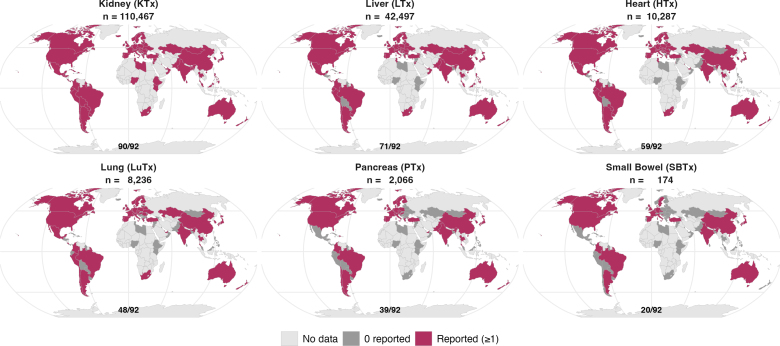
According to the 2024 GODT report, published in Transplantation in 2026, 173,727 solid organ transplants were performed worldwide, representing a 2% increase compared with 2023. Data were submitted by 92 countries.
Kidney transplantation continued to represent the largest proportion of global activity, with 110,467 procedures, followed by 42,497 liver transplants, 10,287 heart transplants and 8,236 lung transplants.
DCD continues to expand
One of the most significant developments is the continuing growth of donation after circulatory determination of death (DCD).
A total of 47,180 actual deceased donors were reported worldwide in 2024. DCD accounted for 28% of deceased donation activity, demonstrating its increasingly important contribution to organ availability.
Developing DCD programmes can contribute to expanding the donor pool, but implementation requires much more than introducing a new clinical protocol. Appropriate legal and ethical frameworks, trained intensive care and donation professionals, clearly defined pathways, hospital coordination, quality assurance and public confidence are essential.
Demand continues to exceed supply
Despite record transplantation activity, global organ availability remains insufficient.
Across the countries reporting waiting-list information, 668,160 patients were reported as waitlisted during 2024, and 31,853 deaths while waiting were recorded. These figures still do not represent the full global burden of organ failure, as many patients live in countries where transplantation services or formal waiting-list systems remain limited or unavailable.
The report therefore illustrates two realities.
On the one hand, transplantation activity continues to grow and strategies such as DCD are enabling more donated organs to be used. On the other, substantial geographical disparities and unmet patient needs persist.
Global progress will require more than increasing the absolute number of transplants. Sustainable national systems must be capable of identifying potential donors, managing donation pathways effectively, training specialised professionals, ensuring ethical and equitable allocation, collecting reliable data and providing lifelong care to transplant recipients.
The latest GODT figures are therefore not only a measure of transplant activity. They also provide an important benchmark for understanding where global donation and transplantation systems are progressing and where further investment and international cooperation are most needed.
Source: Martin F, et al. Organ Donation and Transplantation Worldwide: The Global Observatory on Donation and Transplantation 2024 Report. Transplantation. 2026.
Share this article if you found it useful


 Evidence-based
Related articles
- European Donation Day: the generosity that gives life, the commitment that makes it possible By Francesc Marti
- WHO advances its Global Strategy on Donation and Transplantation By Francesc Marti
- National Organ and Tissue Donation Day in Spain: Celebrating the Gift of Life By Francesc Marti
- Leaving part of your estate to a cause: Your Solidarity Legacy, a new DTI Foundation project By Francesc Marti


Leave your comment here